


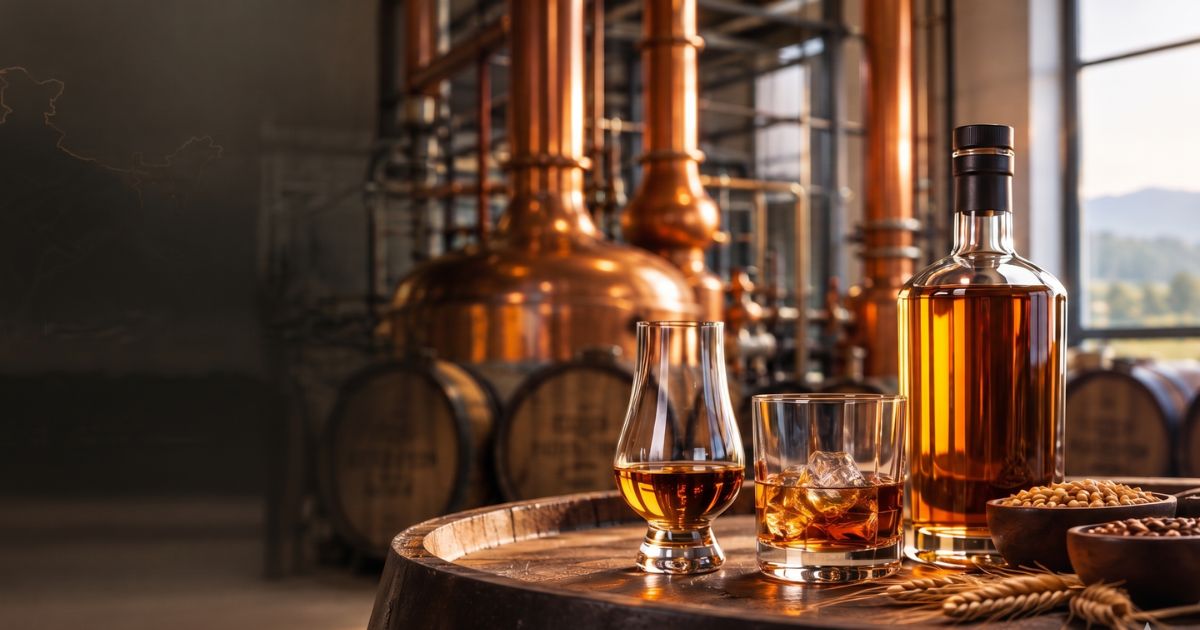
Every bottle on a shelf begins as grain or molasses in a fermentation tank, long before it gets a label. The distillery behind it decides how clean the spirit tastes, how consistent it is from batch to batch, and whether a brand can keep its promise to customers year after year.
That is why brand owners, bottlers and investors keep searching for the best distilleries in India. The country is one of the world’s largest consumers of alcoholic beverages, and spirits sit at the centre of that market. Whoever manufactures the spirit controls much of the quality, cost and reliability of everything built on top of it.
This guide explains how distilleries and breweries differ, who the well-known names are, how a modern distillery actually works, and what to look for when choosing a manufacturing partner.
Breweries and Distilleries Are Not the Same Business
The two are mixed up constantly, yet the difference shapes everything from equipment to licensing.
Breweries ferment malted grain with hops and yeast to make beer, a fermented drink with a relatively low alcohol content. Alcohol distilleries go a step further. They ferment a base such as grain or molasses, then distil the result to concentrate the alcohol. The output can be neutral spirit, which becomes vodka, gin and blended spirits, or aged products such as whisky and brandy.
Both sectors are active. The credit rating agency ICRA reported that beer volumes in India grew by around 3% in FY2025, outperforming spirits. A steady flow of new microbreweries helps beer. Spirits grow more through premiumisation, as consumers trade up to higher-quality products. For anyone entering the industry, the right route depends on the product: brewing suits beer and craft concepts, while distilling underpins spirits, whether you make your own or supply others.
Breweries in India and the Growing Craft Beer Scene
When people look up breweries in India, they usually mean brewpubs and microbreweries, where beer is made on-site and served fresh. Bengaluru, Mumbai, Pune and Delhi NCR are widely known for their craft beer scenes. Jaipur and other tier-two cities are building theirs.
Readers searching for the best brewery in Jaipur, the best brewery in India or the top breweries in India will find that every list reflects its author’s priorities. Some people want fresh small-batch beer, some want a lively atmosphere, and some want consistency across many outlets. A brewpub is judged on what is in the glass. A manufacturer is judged on different things: supply reliability, compliance and repeatability. That second set of criteria matters if you are building a brand rather than visiting one.
Leading Distilleries in India
The map of distilleries India has to offer runs from heritage producers to modern grain-based plants.
- Radico Khaitan’s Rampur Distillery in Uttar Pradesh has been operating since 1943, making it among the oldest in the country. The company has grown into one of India’s largest manufacturers of Indian-made foreign liquor (IMFL).
- Diageo India (United Spirits) is among India’s leading alcobev companies with an extensive manufacturing network spanning multiple states and union territories.
- Amrut (Bengaluru) and Paul John (Goa) helped put Indian single malt whisky on the international map.
- Rajasthan Liquors Limited (RLL) runs a grain-based distillery at Derabassi with a capacity of 120 KLPD. It supplies Extra Neutral Alcohol (ENA) to industry customers and turns its by-products into cattle feed and dry ice.
Names like these come up in any conversation about the top distilleries in India. The more useful question is why some distilleries become dependable partners for other businesses. That comes down to how they make their product and how they run their operations.
How a Modern Liquor Distillery Works
Understanding the process makes it easier to judge quality. In a grain-based distillery, the sequence runs roughly like this:
- Milling and mashing. Grain is ground and mixed with water. Enzymes convert its starch into fermentable sugars.
- Fermentation. Yeast turns those sugars into alcohol. This stage also produces carbon dioxide, which many distilleries now capture instead of releasing.
- Distillation. The fermented liquid is heated in distillation columns. Alcohol evaporates at a lower temperature than water, so it can be separated and collected.
- Rectification. Further column stages refine the spirit to a very high purity. The result is Extra Neutral Alcohol (ENA), a clean, nearly flavourless base used for vodka, gin and many blended spirits.
- By-product recovery. The leftover grain residue can be dried into Distillers Dry Grains and Solubles (DDGS), a protein-rich cattle feed.
Every one of these stages affects the final product. Poor control in fermentation, for example, shows up later as inconsistency in the spirit, which is why serious brand owners ask about process and not just price.
What Makes a Liquor Distillery in India Worth Partnering With?
Brand owners who have been through supplier trouble tend to ask the same questions:
- What is the raw material, and how tightly is the process controlled? Grain-based distillation with modern column systems tends to produce a cleaner, more consistent ENA. Quality at this stage carries through to the finished bottle.
- Can they meet volume without gaps? Capacity on paper and supply in practice are different things. Ask about daily output, not only installed capacity.
- Do they handle compliance properly? Excise and licensing rules differ from state to state, and mistakes are costly. A good partner treats compliance as routine.
- Is every batch the same? For any brand, consistency matters more than one great batch.
- What happens to the by-products? A distillery that wastes its residues is often inefficient elsewhere too. One that turns them into revenue usually runs a tighter operation.
- Can they support your bottling needs? A partner with bottling operations as well as distilling can simplify your supply chain.
How RLL Runs Its Distillery
At Derabassi, RLL’s grain-based distillery is set up to produce 90,000 to 1,20,000 BL of ENA every day. That ENA serves a customer base that includes Seagram, with arrangements for both market distribution and strategic sales.
What stands out is how little goes to waste:
- DDGS is supplied to cattle feed companies such as Kapila Krishi Udyog Limited and Kamdhenu Cattle Feeds Private Limited.
- CO₂ from fermentation is captured and sold. Part of it is compressed into dry ice for commercial and industrial buyers.
So one distillery serves several markets: spirits, agriculture and industry. Alongside its distilling work, RLL operates bottling units in Rajasthan, including Jaipur and Kishangarh. You can read more about its liquor distillery in India operations on the RLL website, or learn about the company on the About page.
Looking at the top distilleries in India is a good way to understand the industry, but a famous name alone does not make a good partner. Capacity, process control, compliance and sustainability do. Whether you are sourcing ENA, planning a new brand or comparing options for a liquor distillery in India, ask detailed questions and look closely at the operation itself.
To discuss ENA supply or distillery services, visit RLL’s distillery page, contact us, write to rllho@rll.co.in or call 0512-2563700.
FAQs
A brewery ferments grain to make beer. A distillery ferments a base such as grain or molasses and then distils it to concentrate the alcohol, producing spirits or neutral alcohol.
Well-known names include Radico Khaitan’s Rampur Distillery, Diageo India (United Spirits), Amrut, Paul John and Rajasthan Liquors Limited. Any list depends on the criteria used, such as heritage, scale, product range or ENA supply.
ENA is a high-purity, nearly flavourless alcohol produced by repeated distillation and rectification. It is the base for vodka, gin and many blended spirits.
Grain-based distillation, combined with modern column systems, gives good control over the process and tends to produce a clean, consistent spirit. It also yields DDGS as a useful by-product.
DDGS stands for Distillers Dry Grains and Solubles. It is a protein-rich by-product of grain distillation, used as cattle feed.
Check the raw material and process control, daily output, regulatory compliance, batch-to-batch consistency, by-product handling and whether bottling support is available.
RLL runs a grain-based distillery in Derabassi and also has bottling operations in Rajasthan. For details on services, visit the RLL distillery page.