


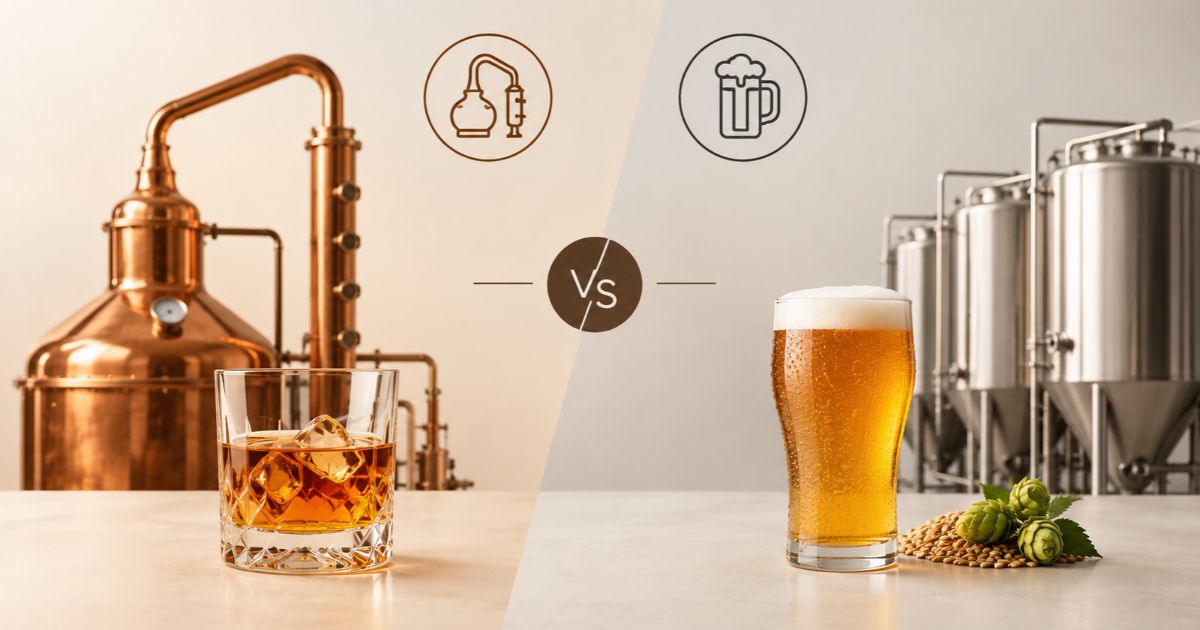
India produces more whisky by volume than almost any country on earth, and its beverages market is worth billions of dollars and growing every year. Yet ask most industry-adjacent professionals to explain, precisely, what separates a distillery from a brewery, and the answers tend to fall apart under any real scrutiny. That gap matters more than it seems because understanding the difference is the first step to understanding where the real value, and the real risk, sits in this industry.
They Start Out Looking Identical
Here’s the part that trips people up first: a distillery and a brewery begin exactly the same way. Grain goes in, water goes in, yeast does its work, sugars convert into alcohol. If you wandered into either facility during fermentation and nobody told you which was which, you’d be hard-pressed to guess. The chemistry is the same. The tanks look the same. Even the smell in the room is roughly the same.
It’s only after fermentation wraps up that the two operations stop pretending to be cousins and go their separate ways.
A brewery stops there. Filter, hop, carbonate, package, ship. Beer typically lands somewhere between 4 and 8 percent alcohol, and nobody in that room is trying to push it higher. That’s the finished product, out the door.
A distillery keeps going. The fermented liquid gets heated, the alcohol vaporises off, gets captured, and condenses back into something far stronger. That’s whisky. That’s vodka. That’s gin. And at industrial scale in India, that same process is how Extra Neutral Alcohol gets made — the base spirit sitting quietly inside almost every IMFL bottle sold in the country.
Same starting line, completely different equipment, completely different regulatory paperwork, completely different economics from that point forward.
What People Picture vs. What a Distillery Plant Actually Looks Like
Ask someone to describe a distillery and you’ll usually get the same mental image: gleaming copper pot stills, a master distiller dipping a tasting ladle into the spirit, oak barrels resting in some quiet, cool cellar. It’s a lovely picture. It also has almost nothing to do with how a modern commercial distillery plant in India actually runs.
The real version is far more industrial, and far less romantic. Production doesn’t stop. Fermentation vessels run continuously, multi-column distillation systems hold tight temperature control around the clock, and behind all of it sits a sprawling support system — boilers, utility lines, storage tanks, and effluent treatment plants working through the by-products that distillation generates hour after hour.
Quality control follows the same relentless rhythm. Nobody waits until a batch finishes to check it. Laboratory teams pull samples throughout the day, because in a plant turning out thousands of litres daily, discovering a problem after the fact usually means an entire run is already compromised. Catching it early isn’t a nice-to-have; it’s the only version of quality control that actually works at that scale.
Raw material logistics catch most people off guard too. A facility producing 100 kilolitres a day needs a constant, tightly scheduled stream of grain arriving on time, every time. There’s no slack built in. A delay that would be a minor inconvenience anywhere else can bring an entire production line to a dead stop here.
Then there’s compliance, and in India this layer is genuinely heavy. Operations answer simultaneously to state excise departments, the FSSAI, the Factories Act, and environmental regulators. Every litre gets tracked, taxed, and reported and running across multiple states means juggling entirely separate regulatory frameworks, each with its own inspection calendar and paperwork trail. Building the infrastructure to handle this properly takes years. Plants that try to shortcut it tend to find out the hard way why that infrastructure exists in the first place.
Breweries Move to a Different Rhythm
None of this makes brewing the “easier” path — it’s simply a different one, running on a different clock entirely.
Timelines are the first obvious difference. Beer can go from brew kettle to shelf in a matter of weeks, while spirits generally need far longer before they’re ready for sale. Setup costs tend to be lower too, especially for a microbrewery, which is exactly why brewing has become such an accessible entry point for first-time founders and smaller brands looking to break into the market.
Tax policy has nudged things along as well. Several Indian states tax beer more gently than spirits, which lowers the financial bar for new breweries right from the start. The exact rules shift state by state, but the overall pull has been enough to draw a steady stream of entrepreneurs toward brewing as a serious business option.
It’s part of why craft beer took off so quickly in cities like Bengaluru, Pune, Mumbai, and Delhi. Microbreweries with taprooms turned into destinations in their own right over the last decade — people weren’t just showing up for a pint, they were showing up for an evening out. Faster turnaround, healthier margins on premium beers, and a growing thirst for something locally brewed gave the whole category real momentum.
India Has Genuine Room for Both
Spirits and beer aren’t really fighting over the same customer. The forces driving each one are different, and both look structural rather than temporary.
On the spirits side, growth is being carried by a rising middle class, expanding demand from urban and semi-urban India, and a clear tilt toward premium products at every price bracket. Interest in quality ENA sourced from a serious distillery company in India has arguably never been stronger. Regional IMFL brands that stayed local for decades are now chasing national scale, and that kind of ambition needs manufacturing partners capable of delivering real volume without letting quality drift.
Beer’s growth story looks completely different. Younger drinkers, less brand loyalty, stronger opinions, and a real appetite for variety are pulling the category forward. Craft beer went from novelty act to established category in roughly a decade, and while its volumes still sit well below whisky nationally, the trajectory isn’t reversing anytime soon.
What ties the two together is a customer base that’s simply gotten harder to satisfy. Across both distillery and brewery India operations, that shift rewards producers who actually take the work seriously — and it exposes the ones who don’t, usually faster than they’d like.
The Part Nobody Says Out Loud
Owning the machinery isn’t the same as knowing what to do with it.
The best distilleries in India didn’t earn their reputation by buying the right equipment. They earned it through decades of showing up consistently, through regulatory relationships built slowly and never rushed, through teams who understand the process well enough to catch a problem before it becomes a disaster, and through systems that hold together even when the day goes sideways.
Rajasthan Liquors Limited has been running grain-based distillery operations out of Derabassi, Punjab for decades, producing ENA at 120 KLPD for institutional clients that include some of the most recognised names in Indian spirits. Those relationships have renewed year after year — not because of a persuasive sales pitch, but because the output has stayed consistent, compliant, and dependable. If you want a closer look at what that kind of operational backbone actually looks like in practice, RLL’s liquor distillery services are worth a look.
Equipment can be purchased outright. That kind of track record has to be earned, one delivery and one audit at a time.
So Which One Is the Better Business?
Neither, honestly. Anyone claiming otherwise is usually selling something.
Both models can generate real returns when the operation behind them is run properly. Both come with capital demands, regulatory complexity, and competitive pressure that newcomers routinely underestimate before they commit. And both are genuinely growing in India for reasons that show no sign of fading.
The more useful question was never distillery versus brewery. It’s whether the foundation underneath either choice is solid enough to actually deliver, day after day, audit after audit. In an industry where quality and compliance decide almost everything, the gap between an operation that’s run well and one that isn’t stops being a minor detail, it becomes the entire business.
India’s beverages market is one of the more genuinely exciting ones in the world right now, and the opportunity across both categories is real. Whether that opportunity turns into a lasting business or an expensive lesson comes down almost entirely to what gets built underneath it.
FAQs
Both start with the same fermentation process, converting grain sugars into alcohol using yeast. A brewery stops there — the fermented liquid is filtered, carbonated, and packaged as beer. A distillery takes that same fermented liquid a step further through distillation, heating it to separate and concentrate the alcohol into spirits like whisky, vodka, or gin, and into Extra Neutral Alcohol (ENA) used across the IMFL industry.
At industrial scale, continuous production is what keeps output consistent and cost-efficient. A plant producing large daily volumes depends on constant fermentation, tightly controlled multi-column distillation, and a steady grain supply — any pause in that cycle, even a short one, can disrupt the entire production line and affect quality across a batch.
Neither is inherently more profitable — the two operate on different timelines, capital requirements, and regulatory demands. Breweries typically have lower setup costs and faster turnaround, often just a few weeks from brewing to market, while distilleries require heavier investment and longer maturation periods but serve a market with strong, sustained premiumisation demand. The right choice depends on the scale, market, and long-term strategy of the business.
Consistency and compliance, more than equipment. Distilleries that maintain long-term institutional relationships typically have years of operational track record, strong laboratory and quality control processes, and the ability to navigate excise, FSSAI, and environmental regulations across multiple states without disruption. That reliability is usually what separates an established supplier from a newer entrant.
ENA is produced through the same distillation process as spirits like whisky and vodka, but it’s refined to a high level of purity and used as the base ingredient in most IMFL products sold across the country. Demand for quality ENA has grown alongside India’s premiumisation trend, making it a core output for many established distillery companies.