


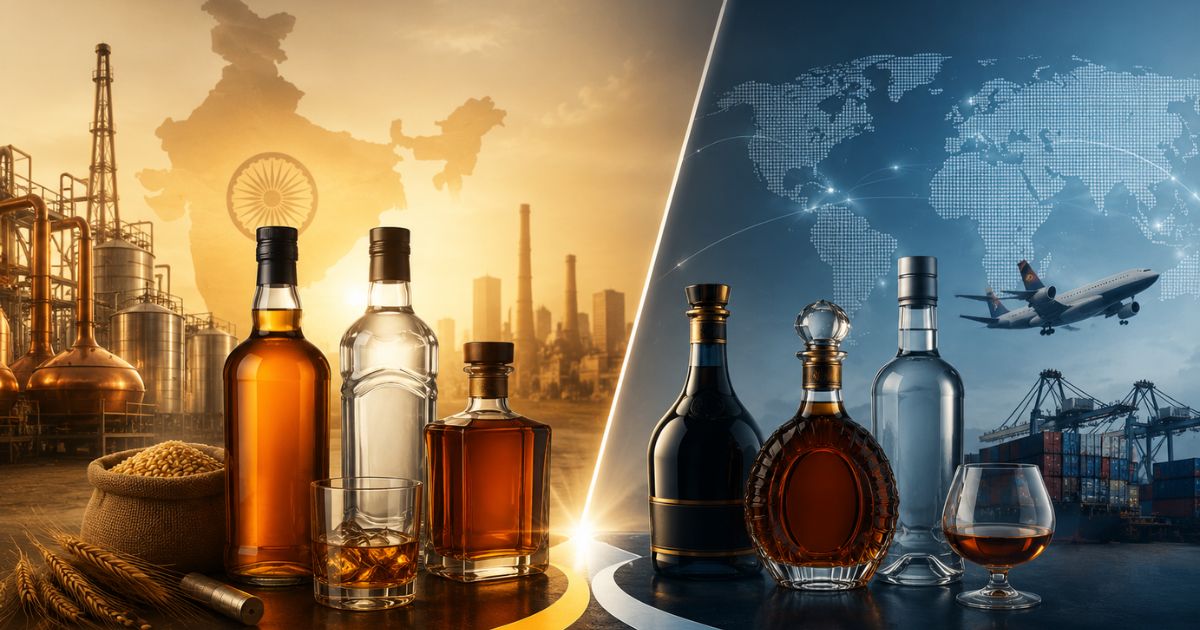
IMFL vs. imported liquor represents the primary fault line in the world’s most dynamic spirits market. While the Indian consumer was once easily categorized by a preference for either “volume” (domestic) or “prestige” (imported), the modern landscape has shifted toward a complex “Premiumization Trap.” For stakeholders, including major liquor manufacturing companies, understanding the nuanced friction between Indian Made Foreign Liquor (IMFL) and Bottled-in-Origin (BIO) imports is no longer just a matter of inventory—it is a matter of strategic survival in a landscape defined by rapid regulatory shifts and an aspirational middle class.
The Structural Anatomy of the Indian Market
To dissect the IMFL vs. imported liquor debate, we must first look at the industrial architecture. India is currently the largest consumer of whiskey globally, yet the “Foreign” in IMFL is often a misnomer for the uninitiated.
1. Defining the Categories
- IMFL (Indian Made Foreign Liquor): This category refers to Western-style spirits (whiskey, rum, gin, vodka) produced within India. Historically, these were primarily molasses-based; however, the new frontier for alcohol manufacturing companies in India is grain-based distillation. This pivot toward extra-neutral alcohol (ENA) derived from grain has allowed domestic spirits to compete directly with global sensory profiles.
- Imported Liquor (BIO): These are spirits produced, aged, and bottled at the source (e.g., Scotland, France, Mexico). They enter the domestic market through specialized alcohol distribution companies, bearing the heavy weight of customs duties and international logistics costs.
The Economic Leverage: Taxation as a Market Shaper
In an analysis of the “cost-to-consumer,” the primary variable is the fiscal burden. Imported spirits are subject to a Basic Customs Duty (BCD) that can reach 150%, a barrier that creates a natural “price floor.” Although things are going to change after the US-India trade deal.
Conversely, liquor manufacturing companies operating domestically navigate a labyrinth of state-level excise duties. This creates a strategic advantage for IMFL: the ability to offer “Affordable Luxury.” By perfecting liquor bottling techniques and localizing production, brands can offer a product that mimics the profile of an imported malt at a 40-60% price discount. This has led to the rise of the “Super-Premium IMFL” segment—a category that is currently seeing the fastest CAGR (Compound Annual Growth Rate) in the sector.
Operational Excellence: The Rise of Domestic Distillation
The quality gap between IMFL vs Imported Liquor is narrowing, driven largely by massive capital expenditures in domestic infrastructure. Leading alcohol manufacturing companies in India like Rajshthan Liquors Limited, are no longer merely blenders; they are innovators.
The Role of Tropical Aging
One of the most significant discoveries by a top whisky manufacturing company in India is the impact of the Indian climate on maturation. While a Scotch may need 12 years to reach peak maturity in the cool, damp Highlands, a spirit aged in distilleries in Rajasthan or other warm Indian regions matures up to three times faster. This “tropical maturation” leads to a high “Angels’ Share” (evaporation) but results in a deeper, more intense extraction of flavors from the wood, allowing IMFL to achieve a richness that challenges imported age-statement whiskies.
Modernizing the Bottling Ecosystem
The aesthetic perception of a brand is as vital as the liquid inside. Today’s liquor bottling companies have moved away from generic packaging. By collaborating with specialized liquor & wine glass bottles manufacturers, domestic brands now utilize bespoke, heavy-base glass that provides the “tactile prestige” previously reserved for high-end imports. These bottling operations are now highly automated, utilizing state-of-the-art alcohol bottling plants that ensure the integrity of the spirit is preserved from cask to glass.
Consumer Psychographics: The Move Toward “Craft”
The modern Indian drinker is “brand-agnostic” but “quality-obsessed.” This psychographic shift has favored the domestic market. Consumers are increasingly seeking out “Indian Craft” labels that tell a story of local terroir. This has inspired spirit distribution companies to diversify their portfolios.
For spirit manufacturing companies, the strategic move has been to establish a liquor distillery in India specifically for “bottling-in-India” (BII) operations. This allows global labels to import the core spirit (concentrate) and bottle it locally, effectively dodging the high BIO customs duties while retaining their international brand status.
Supply Chain Dynamics: Resilience in the Local Market
When evaluating IMFL vs Imported Liquor, one cannot overlook the supply chain. Global spirit distribution is currently fraught with geopolitical risks and rising freight costs. In contrast, liquor manufacturers with a localized footprint benefit from a shorter cash-to-cycle time.
By leveraging wholesale alcohol distributors with deep roots in regional markets, domestic players can ensure their products are present in Tier-2 and Tier-3 cities—areas where imported labels often struggle with consistent availability. The logistical prowess of liquor distillery companies in maintaining a steady flow of inventory during periods of global disruption has solidified IMFL’s dominance in the mass-premium segment.
The Strategic Outlook for Indian mainstream manufacturers and bottlers
As the market continues to evolve, the distinction between IMFL vs Imported Liquor will become even more granular. We are moving toward a “three-tier” market:
- Value IMFL: Molasses-based, volume-driven.
- Premium/Craft IMFL: Grain-based, quality-driven, locally matured.
- Ultra-Prestige Imports: BIO status, heritage-driven.
The future of the industry lies in the hands of players like Rajasthan Liquor Limited, who understand that the Indian palate is no longer a monolith. To capture the next decade of growth, liquor manufacturing companies must focus on “Premiumization at Scale.” This involves not only mastering the art of distillation but also perfecting the consumer’s “unboxing” experience through superior packaging and strategic retail placements.
Conclusion: Navigating the Choice
Choosing between IMFL vs Imported Liquor is ultimately a reflection of the occasion and the consumer’s evolving values. While imported spirits will always hold a specific allure of heritage, the “Made in India” label is becoming a global hallmark of innovation and intensity.
Through the continued modernization of alcohol bottling companies and the strategic expansion of liquor distribution networks, the domestic industry is well-positioned to lead. Organizations like RLL are at the forefront of this transition, ensuring that the spirit of India is not just consumed but celebrated worldwide.
Frequently Asked Questions (FAQs)
Not necessarily. While historically IMFL was considered a “budget” alternative, modern grain-based IMFL produced by top Indian alcohol manufacturing companies often matches or exceeds the quality of mid to even premium level imported spirits. The difference is often in the flavor profile (tropical vs. temperate aging) rather than pure quality.
When a global spirit distribution company opts for “Bottling in India” (BII), they often adjust the blend slightly to suit the local climate and water profile. While the core concentrate is the same, the localized liquor bottling process can result in subtle sensory differences.
Rajasthan is a critical hub for distillation due to its climatic conditions. The heat accelerates wood-spirit interaction, a process perfected by Rajasthan Liquor Limited to create spirits with deep, complex characters that are unique to the region.
Check the label for the “Bottled in Origin” (BIO) tag. If the bottle mentions it was “Produced and Bottled in [Country Name],” it is an import. If it says “Produced/Bottled by [Indian Company Name],” it is classified as IMFL.
Yes. Leading liquor bottling facilities in India now work with premium whiskey bottle manufacturers to create bespoke designs that utilize high-clarity glass, ensuring the domestic product looks as prestigious as any imported label on a home bar.