


There is a version of the alcohol business that looks glamorous from the outside. Premium labels, tasting events, brand ambassadors, aspirational advertising. All of that is real, and for the brands that get it right it is genuinely powerful. But spend enough time around the people who actually run successful spirits operations in India and a different conversation tends to emerge, one that has very little to do with marketing and almost everything to do with paperwork, regulatory relationships, and the unglamorous discipline of staying completely clean across multiple compliance frameworks simultaneously.
The businesses that have built something lasting among liquor companies in India did not do it primarily through branding. They did it by treating compliance as the actual foundation of the business rather than an administrative obligation to be managed around the edges of everything else.
Why Alcohol Is Different From Every Other Industry
Most industries in India operate under a relatively consistent national regulatory framework. You understand the GST structure, you understand the labour laws, you file your returns, and you get on with running your business. Alcohol does not work that way and never has.
Because alcohol regulation in India is a state subject under the Constitution, every state runs its own excise policy, sets its own duty rates, controls its own licensing conditions, and manages its own distribution framework. A liquor company in India operating across multiple states is not dealing with one regulatory environment. It is dealing with several, each with its own inspection schedules, its own reporting requirements, its own rules around pricing and brand approvals, and its own relationship dynamics with the excise officials who ultimately determine how smoothly the business operates day to day.
This is not a temporary complexity that the industry is waiting to see simplified. It is a structural feature of doing business in Indian spirits, and it has been for decades. The companies that have figured out how to navigate it consistently, across states and across years, have built something that genuinely cannot be replicated quickly by a better-funded competitor who has not put in that time.
What Compliance Actually Means at an Operational Level
When people in the industry talk about compliance, they are not just talking about having the right licences on the wall. That is the baseline. What they are actually describing is a set of operational systems that run continuously and reliably across every function of the business.
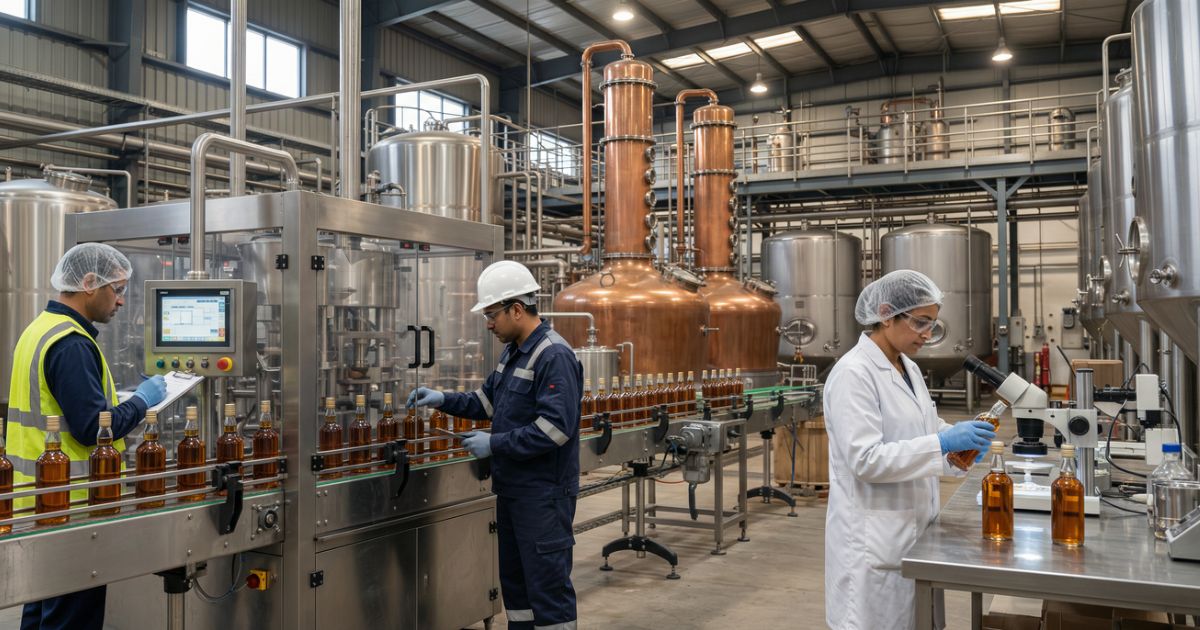
It means production records accurate enough to withstand an excise audit at any point without preparation. It means fill volumes on every bottle consistently meeting the legal standards defined by state authorities, not approximately meeting them, meeting them exactly. It means effluent treatment plants running properly rather than being maintained just well enough to pass scheduled inspections. It means track and trace reporting submitted correctly and on time in the states that mandate it, which is an increasing number.
For a business operating a liquor manufacturing plant in India across multiple geographies, it also means maintaining separate compliance teams or at minimum separate compliance processes for each state, because the rules are different enough that a system designed for Rajasthan will not simply transfer to Punjab or Maharashtra without modification.
The overhead of doing all of this properly is real and it is ongoing. It is also, for the companies that have genuinely built this infrastructure, one of their most durable competitive advantages, because it is exactly the kind of thing that takes years to construct and cannot be shortcut.
The Cost of Getting It Wrong
Regulatory failures in the alcohol business do not tend to be minor inconveniences. They tend to be serious disruptions that affect production schedules, client relationships, and in the worst cases result in licence suspensions that shut down operations entirely while they are resolved.
A manufacturer supplying ENA to an IMFL brand cannot afford a production stoppage. The brand’s own manufacturing schedule depends on that supply arriving reliably, and a compliance-related disruption on the manufacturer’s side becomes a supply chain crisis on the brand’s side very quickly. The same logic applies across the distribution chain. A retailer or hospitality client who cannot get stock because their distributor is dealing with an excise problem does not wait sympathetically. They find another supplier, and rebuilding that relationship afterward is considerably harder than maintaining it would have been.
This is why the liquor manufacturing companies in India that have built genuine institutional client relationships tend to be the ones with the cleanest compliance records. It is not a coincidence. Large IMFL brands and international spirits companies choosing a manufacturing or liquor distribution partner in India are not just evaluating capacity and price. They are evaluating operational reliability, and compliance history is the most concrete evidence of that reliability available.
How RLL Built Its Business Around This Principle
Rajasthan Liquors Limited has been operating in Indian spirits for over three decades, and the through line across that entire period is a compliance-first approach that has made it a trusted partner for some of the most demanding institutional clients in the industry.
RLL’s grain-based distillery in Derabassi, Punjab, operates at 120 KLPD and supplies high-quality ENA to clients including recognised names like Seagram, a relationship that has continued and renewed over many years. That kind of long-term institutional trust does not come from competitive pricing alone. It comes from a manufacturer who shows up correctly, consistently, with product that meets specifications and paperwork that meets regulatory requirements, every time.
The same discipline runs through RLL’s bottling operations, which serve as a dedicated job work partner for PRIPL, the Indian subsidiary of Pernod Ricard, across facilities in Derabassi and Kaladera. Pernod Ricard does not partner with facilities that treat compliance as an afterthought. The fact that RLL has maintained that relationship reflects the depth of the operational infrastructure behind it.
Across its operations in Rajasthan and Punjab, RLL manages excise compliance, environmental obligations, FSSAI requirements, and production reporting across multiple state frameworks simultaneously. That capability, built steadily over decades rather than assembled quickly in response to a client requirement, is what allows the business to take on the kind of institutional partnerships that smaller or newer operators simply cannot credibly pursue. You can explore more about how RLL structures its operations at rll.co.in.
What This Means for Anyone Evaluating the Spirits Business
Whether you are a brand looking for a manufacturing partner, an investor evaluating opportunities in Indian spirits, or an entrepreneur considering entry into the distribution side of the business, the compliance question is the right place to start every conversation.
Not because it is the most exciting question, but because it is the most revealing one. A spirits company that has maintained clean, consistent compliance across multiple states over many years has demonstrated something that no pitch deck can demonstrate: the operational discipline to run a complex, heavily regulated business without cutting corners when cutting corners would have been easier and cheaper.
That discipline is what the best businesses in Indian spirits are actually built on. The branding, the distribution network, the client relationships, all of it sits on top of that foundation. And without it, none of the rest holds up for very long.
FAQs
Because the consequences of getting it wrong are severe enough to threaten the entire business, not just a quarterly result. A licence suspension stops production. A failed excise audit creates a backlog of regulatory problems that can take months to resolve. A supply disruption caused by a compliance failure damages client relationships that took years to build. In most industries, regulatory issues are an inconvenience. In Indian spirits, they can be existential, which is why the companies that treat compliance as a core operational function rather than a background obligation tend to be the ones that are still around after three decades.
It makes national operations significantly more complex than most people outside the industry appreciate. Each state runs its own excise policy, sets its own licensing conditions, and manages its own reporting requirements, so a company operating across five states is effectively managing five separate regulatory environments simultaneously. Pricing is controlled differently in each state. Brand approvals work differently. Inspection schedules differ. A compliance system built for one state will not simply transfer to another without meaningful modification, which is why multi-state operational experience is genuinely difficult to replicate quickly.
Start by asking how long they have been operating and whether they have faced licence suspensions or excise penalties in recent years. Then ask specifically about their track record in the states most relevant to your distribution footprint. A manufacturer who has maintained clean compliance across multiple states over many years has demonstrated something concrete, whereas one who has only operated in a single state or has a shorter history gives you much less to evaluate. Institutional partnerships with large IMFL or international spirits brands are also a strong signal, because those companies conduct their own due diligence before committing to a manufacturing relationship.
It adds cost in the short term and improves profitability significantly over the long term, which is a trade-off that not every operator is willing to make but that the most successful ones consistently do. A manufacturer with robust compliance infrastructure attracts better institutional clients who pay reliably and renew contracts over many years. It avoids the production stoppages and penalty costs that compliance failures generate. And it builds the kind of operational reputation that becomes a genuine competitive advantage when large brands are evaluating manufacturing partners. The companies that treat compliance spending as an investment rather than an overhead tend to build more durable and profitable businesses as a result.
RLL has built its compliance infrastructure steadily over more than three decades of operating in Indian spirits, which means the systems, the teams, and the regulatory relationships are deeply embedded in how the business runs rather than being bolted on in response to a specific client requirement. Operating a grain-based distillery in Punjab and bottling facilities across Rajasthan means managing separate excise frameworks, environmental obligations, and FSSAI requirements simultaneously, and the consistency with which RLL has done this is reflected in its long-standing institutional partnerships with clients like Seagram and Pernod Ricard’s Indian subsidiary, both of which apply rigorous standards to the manufacturers and bottling partners they work with.