


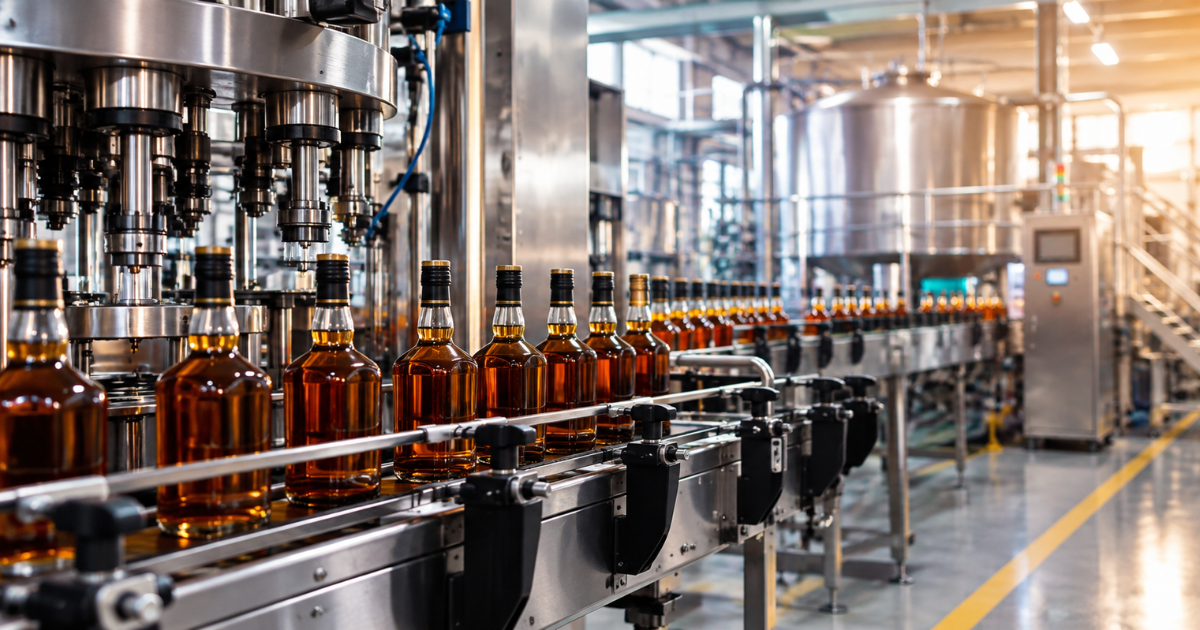
Walk into any wine shop in India and pick up a bottle of whisky. Turn it around. Look at the label, the foil, the capsule, the fill level. Everything looks clean, precise, and uniform. What you are holding is the end result of a production process that most people, including many who work in the spirits industry, never fully think about.
Bottling is not just the last step before a product hits the shelf. It is the step where everything either comes together or quietly falls apart. And in a country as large and logistically complex as India, getting this right is harder than it looks.
The Part of the Industry Nobody Talks About Enough
Most conversations about spirits manufacturing in India focus on the glamorous end: the distillation process, the grain selection, the maturation of whisky, the craft of blending. All of that matters enormously. But the bottling stage is where a product meets its final form, the form in which a consumer will first encounter it, hold it, judge it.
A poorly sealed bottle. A crooked label. Inconsistent fill levels across a batch. These are not minor cosmetic problems. They are brand reputation problems. And in a competitive retail environment where consumers are making split-second decisions on shelves crowded with options, they are problems that cost real money.
This is why, when serious liquor manufacturing companies in India evaluate their supply chain, bottling operations receive just as much attention as the distillery itself. Sometimes more.
Scale Changes Everything
Liquor bottling at small volumes is a relatively forgiving operation. You can manage inconsistencies manually, catch errors before they multiply, and course-correct without too much damage. But the moment you are producing tens of thousands of cases a day, everything changes.
At that scale, a small calibration issue on a filling machine means thousands of bottles with incorrect fill volumes before anyone catches it. A labelling alignment problem at high speed becomes a batch-wide quality failure. Temperature inconsistencies during capping affect seal integrity across an entire run.
This is why the infrastructure behind bottling operations matters so much. Automated lines, real-time monitoring systems, in-process quality checks, and trained technicians are not optional extras at scale. They are the baseline.
RLL’s bottling facility in Derabassi, Punjab runs 12 bottling lines, of which 8 are fully automated, with a combined daily capacity of 40,000 cases. The Kaladera facility in Jaipur adds another 5 lines and 10,000 cases per day. These are not small operations patched together. They are built for the kind of consistent, high-volume output that large IMFL brands need without exception. You can read more about how these bottling operations are structured on the RLL website.
Why Automation Is Not Just About Speed
There is a common assumption that automated bottling lines are primarily about producing faster. Speed is part of it, but the more important benefit is consistency.
A fully automated line removes human variability from the most repetitive and error-prone parts of the process. Filling, capping, labelling, foiling, and inspection, when these are handled by calibrated machines running defined parameters, the output is uniform in a way that manual or semi-automated processes simply cannot match at scale.
For brands supplying to large retail chains or institutional buyers, this consistency is not just nice to have. It is contractually required. A buyer placing an order for 50,000 cases expects every bottle in that shipment to look and behave identically. That expectation is only possible to meet if the bottling infrastructure behind it is built for precision.
Compliance Is Baked Into Every Step
One thing that distinguishes professional bottling operations in India from makeshift ones is how deeply regulatory compliance is embedded into day-to-day production. This is not just about having the right licences on the wall, though that matters too.
It means maintaining accurate production records for excise reporting. It means ensuring that fill volumes meet the legal standards defined by state authorities. It means that packaging materials meet FSSAI requirements. It means that each batch is traceable from input materials to finished goods.
In India, where alcohol is a state subject and every state has its own excise framework, a liquor manufacturing plant in India operating across multiple geographies has to manage compliance simultaneously across different regulatory environments. That requires systems, not just goodwill. RLL’s operations in both Punjab and Rajasthan reflect exactly this kind of multi-state compliance discipline, built over decades of working within some of India’s most demanding excise structures.
What a Good Bottling Partner Actually Looks Like
If you are a spirits brand evaluating your bottling options, here is what to actually look for beyond the standard sales pitch.
First, visit the facility in person. There is no substitute for walking a production floor and seeing how a plant actually runs during an active shift. Look at how raw materials are stored. Look at whether quality check stations are genuinely active or just there for show. Look at the condition of the equipment and how the workforce operates.
Second, ask about their existing client relationships and how long those have lasted. A bottling facility that has maintained long-term partnerships with major IMFL brands has already been through the quality and compliance scrutiny that you are about to subject them to. RLL’s partnership with PRIPL, the Indian subsidiary of Pernod Ricard, for bottling operations across its facilities is the kind of institutional validation that is difficult to argue with.
Third, ask specifically how they handle quality failures when they happen. Every facility has production issues at some point. What separates reliable partners from unreliable ones is not whether problems occur but how quickly and transparently they are addressed.
The Bigger Picture
India’s spirits industry is going through a period of genuine transformation. Premiumisation is real, consumption is rising across urban and semi-urban markets, and brands at every price point are under pressure to deliver a more consistent, professional product experience.
In that environment, the quality of your liquor bottling infrastructure is not a background detail. It is a front-line competitive factor. Brands that invest in getting this right, by partnering with facilities that have the scale, the technology, and the compliance track record to deliver consistently, are the ones that tend to build lasting retail relationships and consumer loyalty.
The bottle on the shelf is the first thing a consumer sees. Making sure it is exactly right, every single time, is what serious bottling operations are built to do.
FAQs
A fully automated line handles every stage, filling, capping, labelling, and inspection, without manual intervention. A semi-automated line still needs human involvement at certain points. For high-volume production, fully automated lines deliver far greater consistency and are better suited to large IMFL brands with strict quality requirements.
A mid-sized brand with pan-India distribution typically needs a partner capable of producing between 5,000 and 15,000 cases per day, with room to scale during peak demand periods. Always check how much of the facility’s capacity is already committed to other clients before signing anything.
Each state has its own excise rules, fill volume standards, and reporting obligations. A bottling partner operating across multiple states must manage separate compliance frameworks for each one simultaneously. This is one of the strongest reasons to work with a facility that already has proven multi-state experience.
Quality checks should run continuously throughout production, not just at the end. Fill volumes, seal integrity, label placement, and foil application all need to be monitored at regular intervals during each run. Catching problems mid-batch is far less costly than discovering them after thousands of cases have already been packed.
Yes, and many of India’s biggest IMFL brands already do. The key is choosing a partner whose standards genuinely match your requirements. RLL’s bottling partnership with PRIPL, the Indian arm of Pernod Ricard, is a clear example of third-party bottling successfully meeting international quality benchmarks.
Beyond capacity and pricing, verify their compliance record, ask to see quality control in action during a live production shift, and find out how they handle mid-batch quality issues. A plant that manages multiple large clients simultaneously without quality slippage is one worth taking seriously.